
Why Privacy-First Age Verification Is Now the Industry Standard
November 27, 2025
Privacy is the Baseline
In 2025, platforms can no longer treat privacy as a nice-to-have, especially when it comes to age verification.
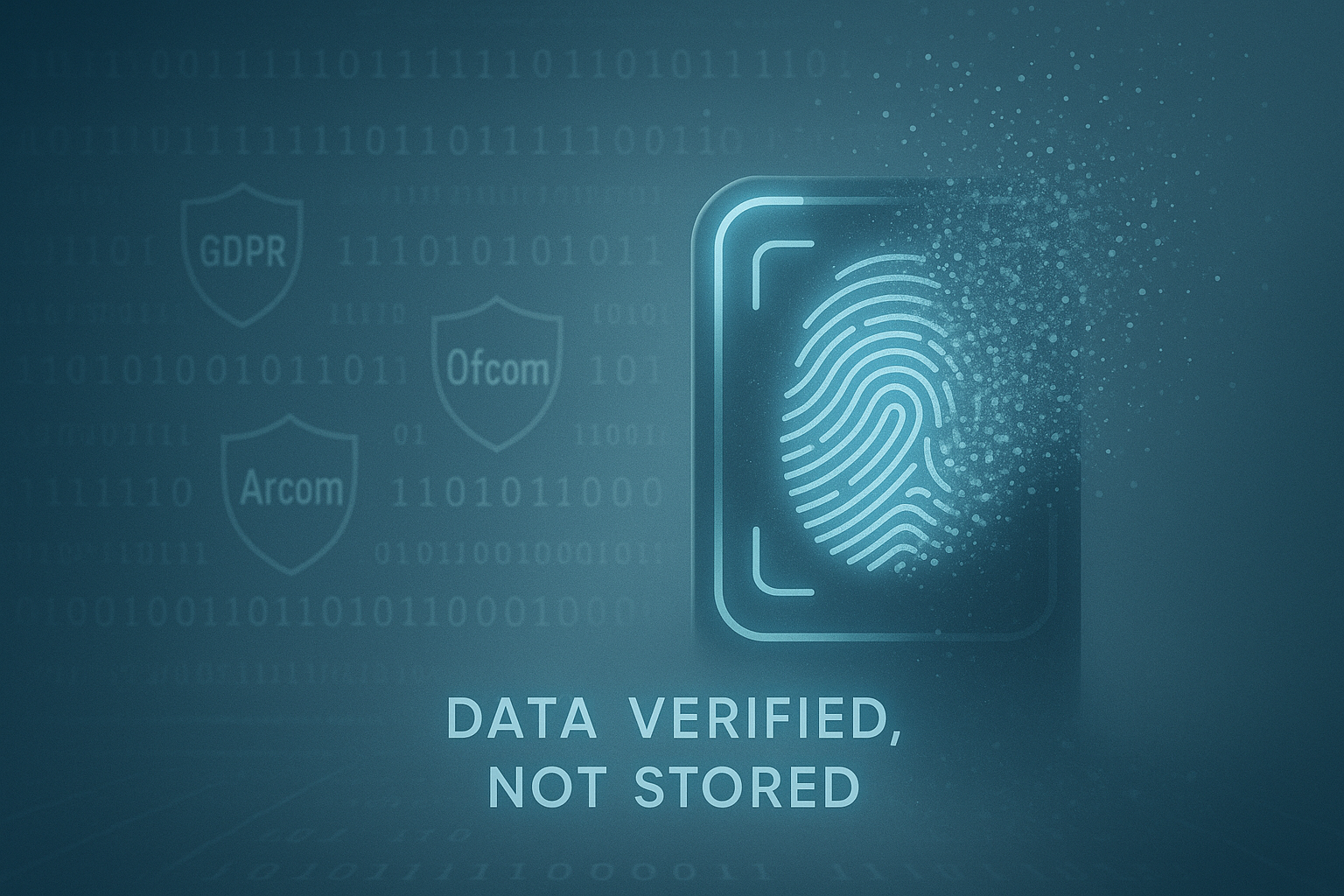
Regulators in the UK, France, and Germany now require age checks that minimize risk, avoid PII retention, and respect user anonymity. Collecting IDs, storing selfies, and logging biometric templates isn’t just unnecessary — in many cases, it’s legally indefensible.
That shift forces a new reality: You’re not just expected to prove a user is old enough, and you’re expected to do it without ever storing who they are.
Compliant Non-Compliance
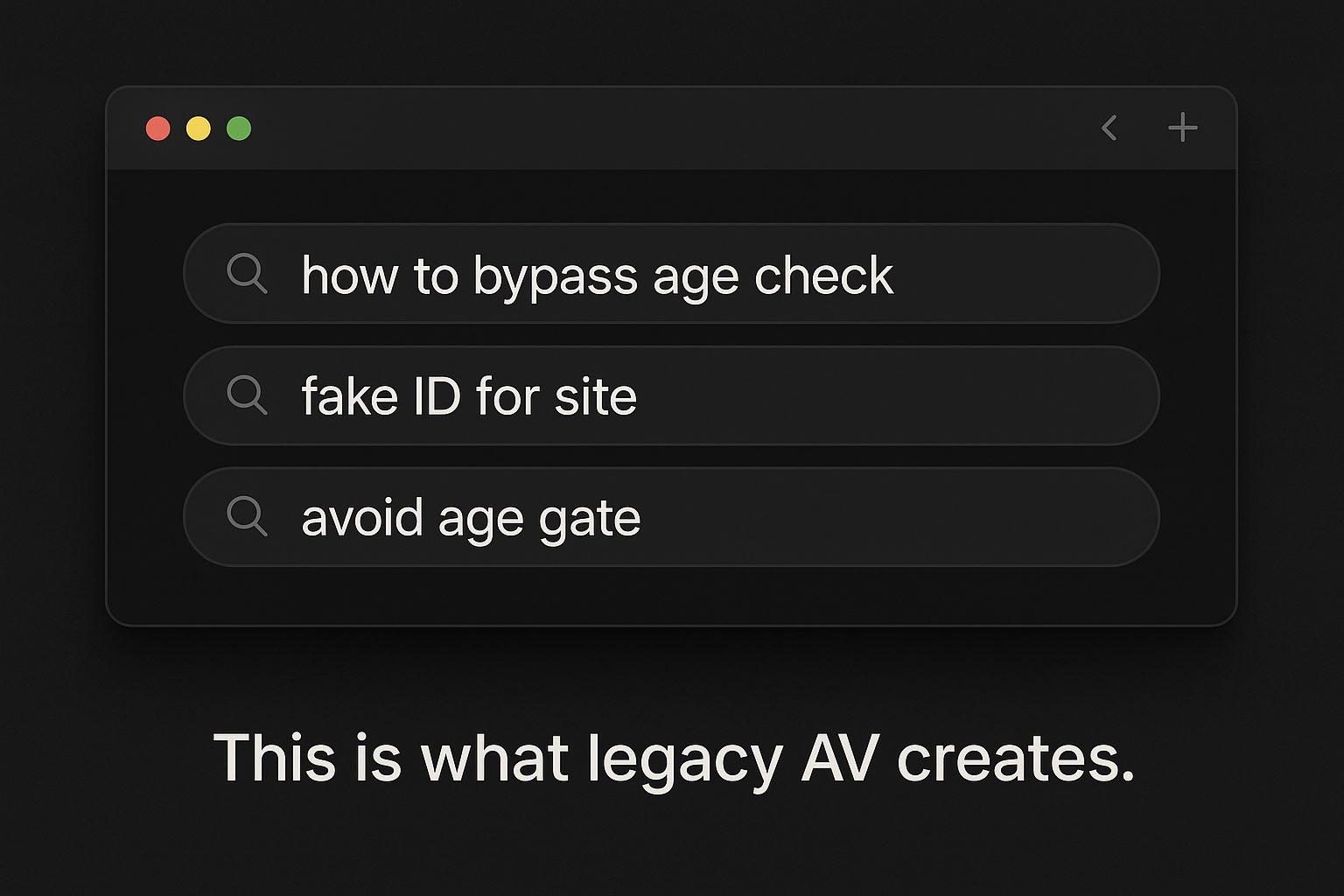
Let’s be honest: most users don’t “participate” in age verification — they try to get around it.
Searches like “how to bypass AV,” “get around age checks,” and “fake ID for porn site” are spiking. Reddit threads swap tips. VPNs promise workarounds. The user mindset has gone completely defensive instead of cooperative, and nobody can blame them.
Legacy AV systems often demand:
- Full government ID uploads
- Facial scans with unclear retention policies
- Redirects to third-party flows that look more like phishing than protection
The result? Mistrust. Resistance. Drop-off.
That’s not a user problem, it’s a system design problem. If verification is fast, private, and certificably doesn’t store anything, users have less of a reason to fight it.
Privacy-first AV doesn’t just reduce friction — it disarms the impulse to circumvent.
Why Regulators Now Favor Ephemeral Systems
Every major regulator in the world now favors privacy-preserving, ephemeral AV systems:
- Ofcom (UK) mandates “data minimization” and warns that any system storing unnecessary personal data risks non-compliance.
- Arcom (France) requires systems to be binding, independent, auditable, and privacy-safe, explicitly disfavoring AV flows that store user data.
- KJM (Germany) mandates controlled biometric verification and restricts storage, especially for facial images and ID scans.
- FTC & COPPA (United States) require verifiable parental consent for underage users, and increasingly scrutinize platforms for how long data is retained, especially facial images, biometrics, and identifiers.
- Several U.S. states (e.g. California, Utah, Arkansas) are also passing age verification mandates with strict privacy clauses, reinforcing the trend toward zero-retention architectures.
In every jurisdiction, the message is clear: verify effectively, and never store anything.
What a Privacy-First AV System Actually Looks Like
True privacy-first AV isn’t about deleting user data eventually. It’s about never storing it at all.
A compliant, conversion-friendly system should offer:
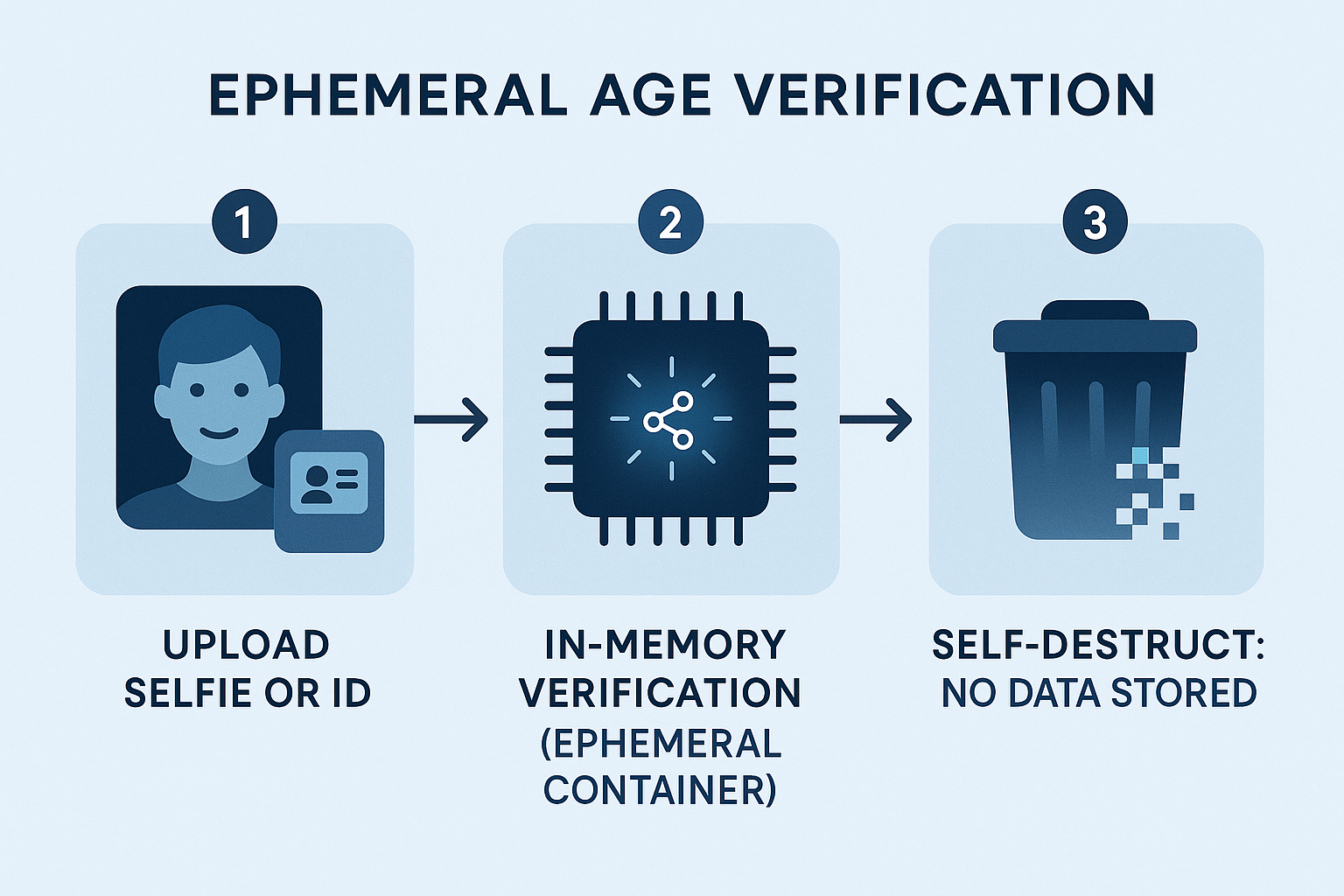
- In-memory processing only — Data is never written to disk
- No biometric or PII retention — No selfies, no ID scans, no hashes
- Ephemeral infrastructure — Processing containers self-destruct after verification
- Double-anonymity by design — The AV provider doesn’t know where the user came from, and the platform doesn’t retain what they submitted
Anything less invites resistance — and exposes your platform to scrutiny, if not enforcement.
SafePassage: AV That Doesn’t Give Users a Reason to Be Upset
SafePassage was built from the ground up to meet the highest regulatory bar without storing any user data, ever. It’s not a retrofitted KYC product. It’s not a one-size-fits-all ID scanner. It’s a real-time, privacy-first verification system designed for platforms under real legal pressure.
We offer:
- L1: Facial age estimation (15–20 seconds) — No ID required
- L2: ID + biometric match (under 60 seconds) — For high-assurance jurisdictions
- Zero storage — All data processed in RAM and deleted instantly
- Compliance alignment — Built for Ofcom, Arcom, KJM, Coppa, and more
With SafePassage, there’s no retention, no privacy risk, and no reason for users to fear where their data ends up.
Shifting Industry Standards
Privacy-first AV isn’t a niche position anymore. It’s the regulatory default, the user expectation, and the only option for platforms that don’t want to be in a courtroom six months from now.
If you’re evaluating age verification in 2025, ask yourself: will users trust it enough to stop trying to avoid it?
If the answer isn’t clear, then the provider isn’t ready. We at SafePassage are, however — try us out for now, or follow us on X, Bluesky, and LinkedIn for more compliance-related content.