
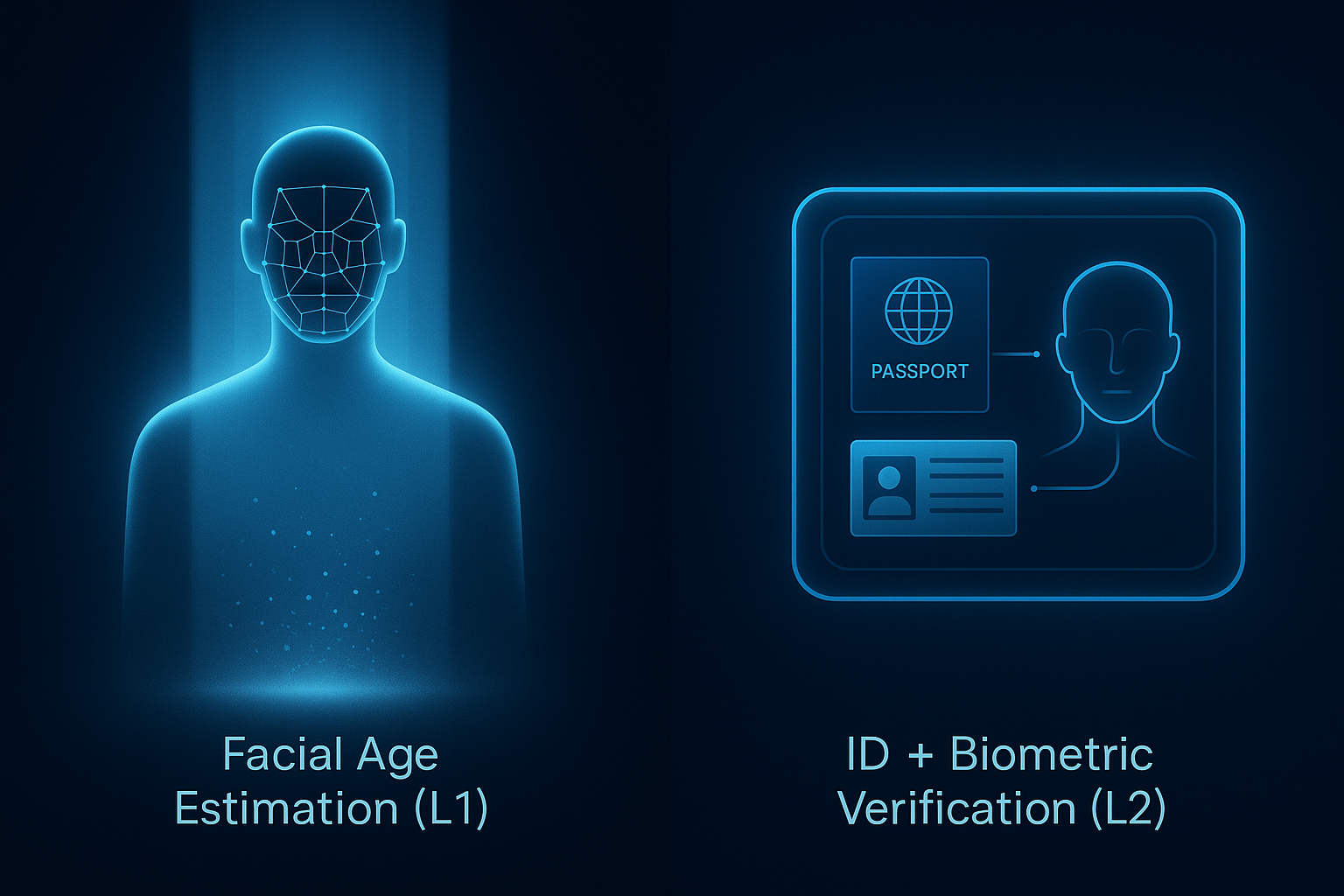
Facial Age Estimation vs. ID Verification: What’s Right for Your Platform?
Choosing the right age verification method in 2025 means balancing risk, compliance, and user experience — all without compromising privacy, of course. Let’s see what the most common two verification options look like.
One Problem, Two Very Different Solutions
Every adult platform needs age verification. That part is non-negotiable in 2025 — especially in regulated markets like the UK, France, Germany, or the US. But what kind of verification you use still depends on your product, your audience, and your legal risk profile.
Most providers offer one of two options:
- Facial Age Estimation (L1)
- ID + Biometric Verification (L2)
Both are legal, regulator-certified, but they’re not interchangeable at all. Choosing the wrong one can mean user drop-off, excessive data exposure, or worse: non-compliance.
Here’s what to know before you commit.
Facial Age Estimation (L1): Fast, Private, Frictionless
Facial age estimation uses AI to analyze a live selfie and determine whether a user appears to be over or under a specific age threshold — usually 18, 21, or 25, depending on jurisdiction.
When It Works Best
- Teasers, previews, and limited content gates
- Platforms serving mixed-risk geographies (e.g., US, UK, Canada)
- Mobile-heavy traffic that can’t tolerate friction
- Brands focused on privacy or anonymity
Compliance Fit
- Approved by Ofcom (UK)
- Approved by Arcom (France) when paired with privacy protections
- Not sufficient alone for KJM (Germany)
Key Benefits
- No ID required
- Fast verification times
- Ideal for keeping conversion high
If your platform needs to verify age without spooking users, L1 is the tool. But it’s not enough on its own if you're dealing with more strict jurisdictions like Germany, or publishing high-risk content.

ID + Biometric Verification (L2): Maximum Assurance
L2 flows require a user to present both a live selfie and a government-issued ID. The system performs OCR, face matching, liveness checks, and returns a binary result.
When It’s Required
- Full-scene access or explicit content in regulated markets
- German traffic (KJM mandates high-assurance verification)
- Environments with legal exposure or public scrutiny
- When your legal team insists on zero risk
Compliance Fit
- Fully compliant with Arcom, Ofcom, and KJM
- Meets “binding, auditable, irreversible” criteria in France
- Passes KJM’s technical certification (Germany)
Key Benefits
- Highest level of regulatory protection
- Usually includes cryptographic audit trails
- Accepted in every major EU jurisdiction
- Can be layered behind L1 for selective escalation
If you need full compliance coverage, this is the gold standard — but it comes with higher user friction, especially on mobile.

Which One’s Right for You?
If you’re unsure which verification mode fits your platform, start with three questions:
- Where are your users located?
- What type of content are you gating?
- What level of liability are you willing to carry?
If the answer includes strict jurisdictions, explicit content, or legal exposure — use L2.
If the answer is mobile, global, or conversion-sensitive — start with L1.
If you're serious about getting it right, though, there’s a third choice.
The Best Platforms Use Both
The most effective approach in 2025 is a hybrid model:
- Use L1 facial estimation by default for speed, privacy, and conversion
- Escalate to L2 ID verification based on geography, user behavior, or content type
This dynamic model gives you flexibility without introducing legal gaps. You stay compliant in strict jurisdictions and frictionless everywhere else, all with a single integration.
SafePassage is one of the few AV platforms offering both L1 and L2 in a single privacy-first, regulator-approved system.
- 15–20 second facial estimation (no ID, no storage)
- Sub-60 second ID + biometric flows (ephemeral, secure)
- Regulator-compliant across UK, France, Germany, US, and more
- Built-in support for dynamic escalation by risk or country
You don’t have to choose between conversion and compliance: you can have both, all without storing any user data. Try SafePassage today for free, and follow us on X, BlueSky, and LinkedIn for more age verification content.